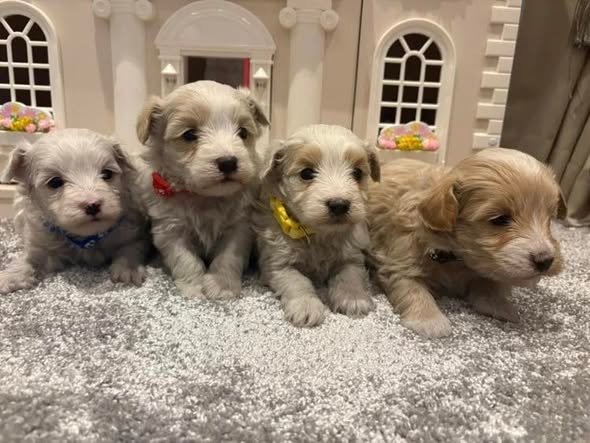
The Maltipoo.
Small dog,
enormous personality.
The Maltipoo isn't a breed that needs selling — once people meet one, that's usually it. But if you're still deciding, here's everything honest we can tell you about what living with one is actually like.


generation
Two of the best breeds.
Combined deliberately.
The Maltipoo is a cross between the Maltese and the Miniature Poodle. Neither parent is chosen by accident. The Maltese brings centuries of companion dog breeding — gentle, loyal, and built entirely for human company. The Miniature Poodle brings one of the highest dog intelligence rankings recorded and a coat that barely sheds.
What you get from the combination is a dog that fits into almost any living situation, learns quickly, and forms bonds that last the full length of their 12–16 year life. The "designer dog" label gets thrown around a lot — but with the Maltipoo, the genetics have a real point.
We breed F1 Maltipoos, which means a direct cross between a purebred Maltese and a purebred Miniature Poodle. F1 offspring benefit from hybrid vigour — they tend to be healthier and more robust than either parent breed in isolation. This is part of why we test both parents so thoroughly.
See our health testing process →Six things that make a Maltipoo a Maltipoo
Deeply affectionate
Maltipoos don't do indifference. They want to be near you — on the sofa, following you from room to room, resting their head on your foot. If your idea of a good dog is one that keeps its distance, this probably isn't the breed. If it's one that's actually present, they're hard to beat.
Genuinely clever
The Poodle side of the mix comes with real intelligence. Maltipoos pick up commands faster than most breeds and they remember them. That cuts both ways — they learn good habits easily, but they'll also figure out how to push boundaries if you're not consistent.
Adaptable to any home
We've placed Maltipoos into city flats, large family houses, homes with other dogs, homes with cats, households with young children and households with elderly owners. They adjust. What matters more than space is whether they get enough time with their people.
Good with children
Our puppies are raised alongside our own children from birth. They're used to being handled, held, and occasionally over-loved by small people. That said, every dog has limits — we always advise supervising young children with any dog, regardless of breed.
Low-shedding coat
This is usually the thing that tips the decision for allergy sufferers. Maltipoos don't shed the way most dogs do — there's no cloud of fur when they shake, no covering on the furniture. They still need regular grooming and brushing, but they're genuinely manageable for people who've struggled with other breeds.
Energetic but not exhausting
They want to play and they want walks — but they're not a breed that'll destroy your house if they miss a day out. A good 20–30 minutes of activity and some mental stimulation (training counts) is usually enough to keep them content. They're happy to wind down on the sofa when you are.

Every Maltipoo coat is a little different
Coat type varies depending on which parent they take after more. Most of ours fall somewhere in the middle — wavy to softly curly, with a texture that's more plush than wiry. Here are the main colour variations you'll see.
Cream & Apricot
The most common in our litters. Warm, golden tones that often lighten with age. Very popular for a reason.
Apricot & Tan
Richer colour with a hint of red. Tends to hold its colour better through adulthood than paler coats.
Chocolate & Brown
Less common but striking. Deep rich tones that can range from milk chocolate to dark espresso.
White & Ivory
Classic Maltese influence coming through. Beautiful but requires a bit more maintenance to keep clean.
A healthy breed, with a few things worth knowing
Maltipoos are generally healthy dogs with a longer lifespan than most breeds their size. Hybrid vigour from the F1 cross works in their favour. But there are a few conditions that show up in the parent breeds that buyers should be aware of — which is exactly why we test for them.
Patellar luxation
A knee joint issue common in small breeds. Both parents are tested. Mild cases rarely cause problems; severe cases can be corrected surgically. Our testing significantly reduces the risk.
Progressive retinal atrophy (PRA)
An inherited eye condition that can lead to vision loss over time. DNA testing identifies carriers — we do not breed from dogs that carry two copies of the gene.
Mitral valve disease
More common in older Maltese. Not something DNA testing catches directly, but cardiac screening of our breeding dogs is part of our annual health checks.
Epilepsy
Rare, but worth flagging. There is a genetic component in Poodle lines. We screen for this and it hasn't appeared in any of our litters to date — but we disclose this openly because it exists in the wider breed population.

What to expect as they grow
8 Weeks
1–2 kgWhen they usually come home
6 Months
2.5–4 kgRapid growth phase ends
1 Year
3–6 kgClose to final adult weight
Height
8–14 inMeasured at the shoulder
Note: Maltipoos can vary significantly in size depending on whether they take after the Maltese or Miniature Poodle parent. Females tend to be slightly smaller than males.
A match made in heaven... mostly.
Maltipoos are incredible companions, but every breed has its quirks. Make sure your lifestyle aligns with what they need to thrive.
-
✓You want a highly affectionate indoor companion.
-
✓You suffer from mild allergies and need a low-shedding dog.
-
✓You live in an apartment or smaller home without a massive garden.
-
✕You work 12-hour shifts away from home and can't provide company.
-
✕You don't have the budget or time for regular professional grooming.
-
✕You are looking for a rugged, outdoor hiking companion for extreme weather.
Frequently Asked Questions
No dog is 100% hypoallergenic, but Maltipoos are highly allergy-friendly due to their low-shedding hair (rather than fur). They are a great choice for mild to moderate allergy sufferers.
They can be vocal and alert you to visitors, taking after their Poodle heritage. Early training and socialization significantly help manage excessive barking.
They require daily brushing to prevent matting and professional grooming (clipping) every 4 to 6 weeks. Their coat requires maintenance.
Ready to welcome a Maltipoo?
View our current litters or get in touch to ask us anything about our breeding program.